


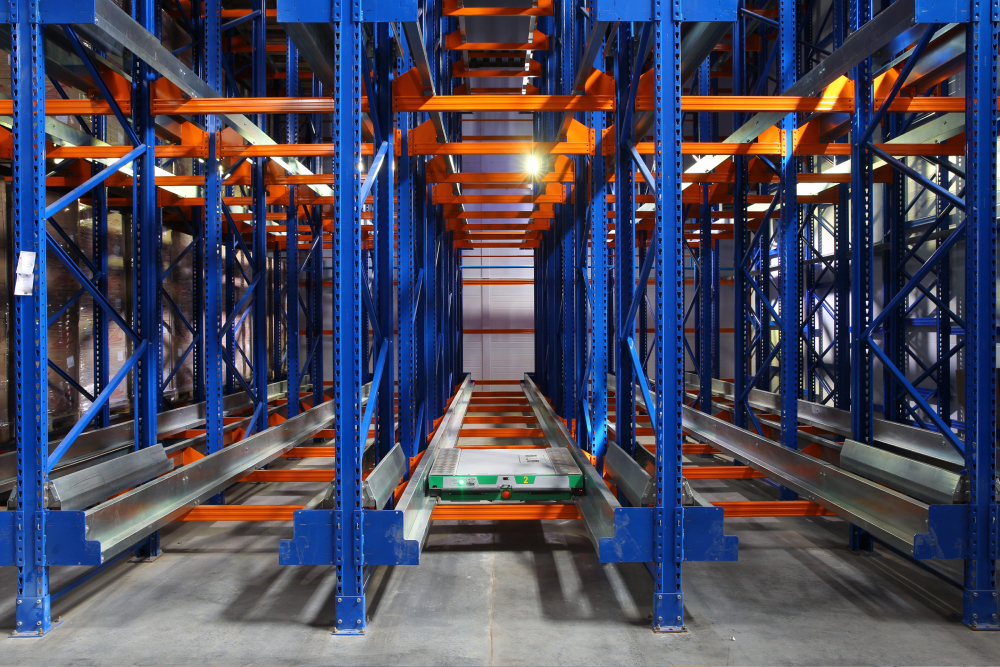
Warehouses today must store more inventory, improve accuracy, and enhance productivity often without expanding their physical footprint. Automated Storage and Retrieval Systems (ASRS) offer a strategic advantage by maximizing cubic utilization, optimizing inventory placement, and streamlining operations. With the right ASRS solution, warehouses can dramatically increase capacity while improving workflow efficiency.
1. Transforming Underused Areas into High-Density Storage
Traditional storage relies heavily on manual picking and forklifts, which require wide aisles and limit safe rack height. However, height and aisle usage vary by equipment type and safety regulations. ASRS systems overcome these limitations by enabling narrower aisles, taller storage structures, and automated goods-to-person workflows. Depending on building height and SKU characteristics, ASRS can increase storage density by 40% to 85%. The ability to utilize full ceiling height allows businesses to delay or eliminate costly warehouse expansions.
2. Intelligent Inventory Placement for Maximum Efficiency
Manual storage often leads to inconsistent slotting, clutter, and slower retrieval times. ASRS integrates with Warehouse Management Systems (WMS) and Warehouse Execution Systems (WES) to optimize slotting based on item velocity, size, weight, and handling requirements. Fast-moving SKUs are stored for quick access, while slow movers are placed deeper or higher. Intelligent placement ensures predictable, efficient, and high-density storage, reducing search time and increasing throughput.
3. Leveraging Vertical Height Safely and Effectively
Most warehouses have tall ceilings but cannot fully utilize this height through manual operations. ASRS technologies including unit-load cranes, mini-load shuttles, vertical lift modules (VLMs), and horizontal/vertical carousels enable safe, automated use of vertical space. Unit-load cranes support palletized loads at extreme heights, while shuttle and mini-load systems handle cartons and totes at high speeds. VLMs and carousels maximize density for small parts and components. By engineering systems that match building height and structural capacity, businesses unlock valuable overhead space.
4. Improving Workflow and Reducing Floor Congestion
Traditional picking creates floor congestion due to constant worker and forklift movement. ASRS minimizes this by bringing goods directly to operators, reducing travel time, improving accuracy, and enhancing workflow predictability. While forklifts may still be required for replenishment or pallet staging, overall floor traffic significantly decreases, improving safety and operational flow.
5. Types of ASRS and Their Applications
Unit-load ASRS handles pallets and heavy loads with tall, high-density racking. Mini-load systems handle totes or cartons at high speed. Shuttle systems provide exceptional throughput across multi-level storage. Vertical Lift Modules offer compact goods-to-person operation, while carousels provide efficient small-parts picking. Each solution varies in speed, cycle time, and density, making selection dependent on SKU mix and throughput needs.
6. Engineering Considerations for ASRS
Key engineering factors include load dimensions, tray/bin sizes, weight capacity, cycle time expectations, throughput modeling, environmental requirements, and fire and seismic conditions. Accurate master data is critical for proper slotting and system reliability. Integration with WMS/WES ensures system intelligence is fully utilized.
7. Safety & Compliance Requirements
ASRS systems must comply with OSHA, ANSI, and NFPA fire safety standards. Proper machine guarding, fall protection, safe access for maintenance, and Lockout/Tagout (LOTO) procedures are essential for operator safety and regulatory compliance.
Summary
ASRS systems enable warehouses to maximize cubic capacity, improve accuracy, and enhance operational clarity. By combining intelligent software, vertical storage optimization, and goods-to-person technology, ASRS allows businesses to achieve higher efficiency and long-term scalability without increasing their footprint.
ALSO READ
ASRS Systems vs Traditional Storage: Which is Right for Your Warehouse?
How ASRS Enhances Workplace Safety and Reduces Manual Labor
How to Choose the Right Warehouse Conveyor System for Your Business


