

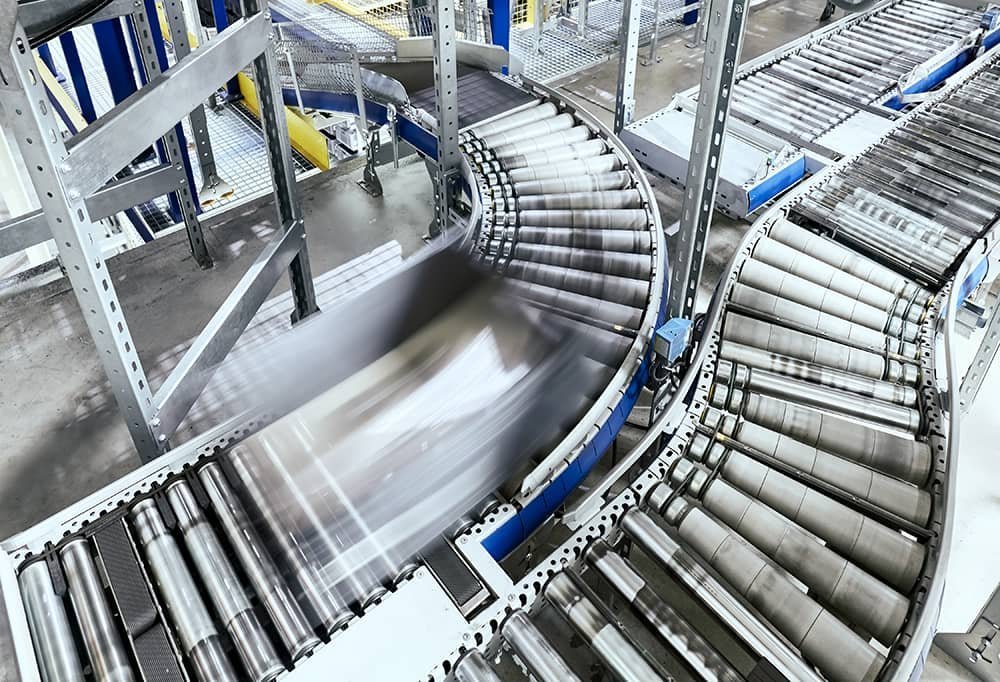
Selecting the right roller conveyor manufacturer plays a vital role in achieving efficient, flexible, and scalable material handling operations. Roller conveyors are widely used for transporting cartons, totes, pallets, and unit loads across warehouses and production facilities. A modern manufacturer goes beyond basic equipment supply, delivering engineered solutions that meet today’s operational demands and future growth requirements.
1. Wide Range of Roller Conveyor Technologies
A modern roller conveyor manufacturer offers multiple roller conveyor types to suit different applications. These include gravity roller conveyors for simple movement, powered roller conveyors for controlled flow, Motorized Drive Roller (MDR) systems for energy-efficient zoned accumulation, and Chain-Driven Live Roller (CDLR) conveyors for heavy or palletized loads. Offering this range allows manufacturers to recommend the most suitable technology based on load, speed, and throughput requirements.
2. Engineering-Driven System Design
Today’s roller conveyor systems must be engineered not standardized. A professional roller conveyor manufacturer evaluates load weight, product dimensions, center of gravity, SKU variety, and operational speed before finalizing a design. This ensures stable tracking, smooth transitions, and reduced product damage. Engineering precision also improves system reliability and minimizes maintenance issues over time.
3. Flexible Layout and Modular Design
Modern warehouses demand flexibility. A reliable roller conveyor manufacturer designs modular systems that can adapt to space constraints and future expansion. Thoughtful layouts account for turning radii, conveyor transitions, maintenance access, and operator walkways. Modular designs make it easier to extend or reconfigure the system as business needs change.
4. Energy-Efficient and Smart Conveyor Solutions
Energy efficiency has become a major priority. Modern roller conveyor manufacturers increasingly recommend MDR systems, which use decentralized motors and operate only when product is present. This significantly reduces energy consumption, noise levels, and wear compared to traditional line-shaft systems. Smart controls also allow zone-based operation and improved accumulation logic.
5. Seamless Integration with Automation and Controls
A modern roller conveyor manufacturer ensures compatibility with Warehouse Management Systems (WMS), Warehouse Execution Systems (WES), barcode or RFID scanning, and PLC controls. Communication protocols such as EtherNet/IP or PROFINET enable real-time tracking and decision-making. Proper integration improves flow coordination and reduces manual intervention.
6. Focus on Safety and Compliance
Safety-focused design is a key feature of a professional roller conveyor manufacturer. Systems are built to comply with OSHA, ANSI, or CE standards, incorporating guarding, emergency stops, safe-speed controls, and lockout/tagout provisions. These measures protect operators while maintaining system uptime.
7. Long-Term Support and Maintenance Considerations
Modern manufacturers prioritize lifecycle support. Easy access to rollers, bearings, and drive components simplifies maintenance. Standardized parts reduce downtime and spare inventory requirements. Reliable after-sales support ensures the conveyor system continues to perform as operational demands grow.
Conclusion
A modern roller conveyor manufacturer delivers more than equipment they provide engineered, energy-efficient, and scalable solutions tailored to real operational needs. By partnering with the right manufacturer, businesses can achieve smoother material flow, lower operating costs, and a conveyor system built for long-term performance and growth.


Leave a Reply