 Address:


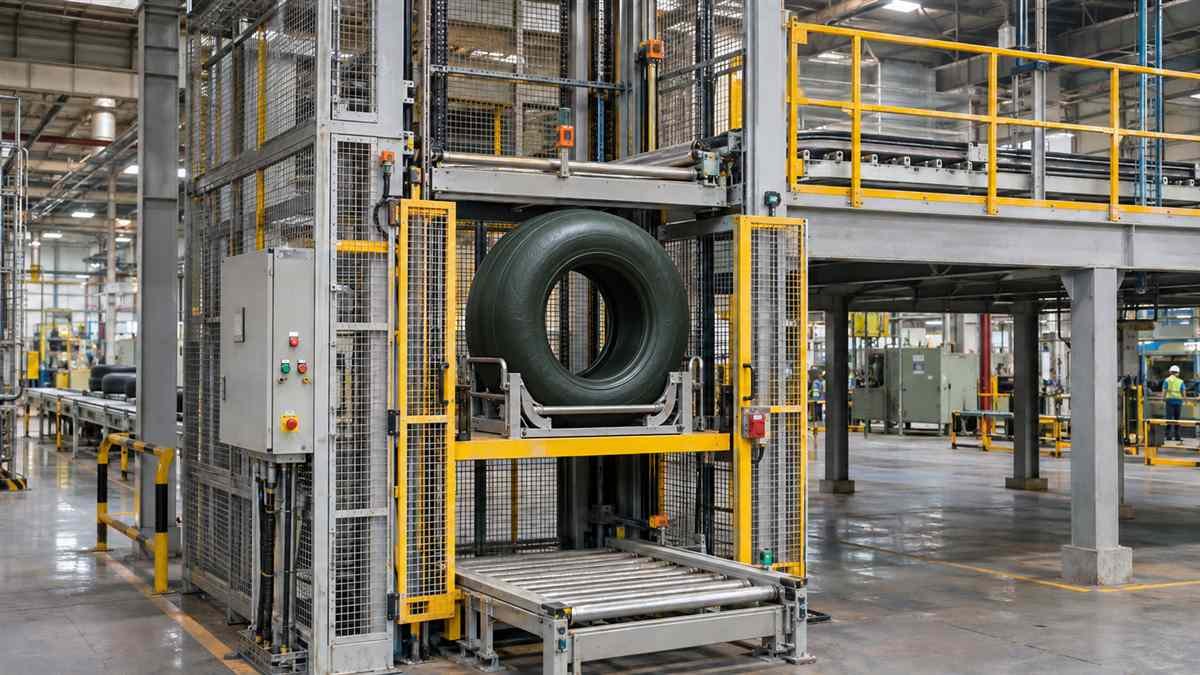
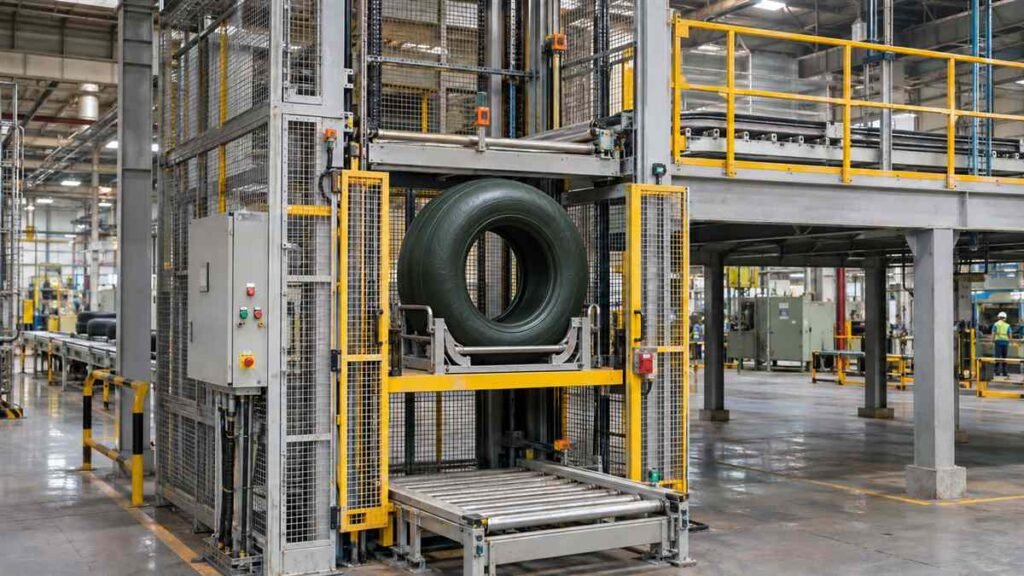
In a tyre manufacturing plant, production does not stop at the tyre-building machine. Materials and tyres must continue moving between different stages, including building, curing, inspection, storage, and dispatch.
The difficulty begins when these stages are located at different floor levels.
A plant may have curing presses on one level, inspection equipment on another, and storage or packing areas somewhere else. If tyres or carriers have to be moved manually between these levels, the result can be delays, unnecessary handling, safety concerns, and avoidable pressure on production teams.
This is where material handling lifting equipment can improve the movement of tyres and production carriers between different elevations.
Why vertical movement matters in tyre manufacturing
Tyre production involves several connected stages. Semi-finished materials are assembled into a green tyre before the tyre moves to curing, where heat and pressure give it its final shape. Finished tyres then go through quality checks before they are sent to storage or distribution.
These stages do not always fit neatly on one floor.
For example, a tyre plant may use:
- Ground-level material feeding
- Elevated conveyor lines
- Curing presses positioned in rows
- Inspection stations on another level
- Finished-tyre storage below or beside the production area
When the layout includes these changes in elevation, a vertical lifter can act as the connection between two conveyor lines or workstations.
Instead of using a long ramp, repeated forklift movement, or manual lifting, the carrier can be transferred vertically in a controlled cycle.
A practical example from a tyre plant
Imagine a plant where green tyres are prepared on one level and need to be transferred to curing presses positioned above the main production floor.
Without a properly designed vertical transfer system, operators may need to:
- Move tyres to a temporary staging area.
- Wait for a forklift or handling vehicle.
- Transfer the tyres to the higher level.
- Align them with the next conveyor or machine.
- Repeat the process throughout the shift.
Each extra step creates an opportunity for waiting, misalignment, congestion, or product contact with unsuitable surfaces.
With a conveyor-integrated lifter, the carrier can arrive at the lifting station, move to the required level, and transfer directly to the next conveyor. The actual design depends on the tyre size, carrier arrangement, elevation, speed, and production sequence, but the principle remains the same: reduce unnecessary movement between connected operations.
1. Improving production flow
Production flow is affected by more than the speed of an individual machine. If material movement between machines is slow, the entire line can experience interruptions.
A lifter can help maintain a predictable transfer cycle between levels. This is particularly useful when:
- A curing area operates continuously
- Multiple tyre sizes are produced on the same line
- Inspection stations are located away from the curing section
- Finished tyres must be transferred to storage
- A plant has limited floor space for ramps or staging zones
A well-integrated lifting system can reduce the need for temporary storage points. That helps production teams maintain a clearer flow and makes it easier to identify where delays are occurring.
The goal is not simply to move a tyre upward or downward. The goal is to connect two parts of the process without creating a new bottleneck.
2. Reducing unnecessary tyre handling
Tyres can be heavy, flexible, and difficult to handle consistently, especially when different sizes are produced on the same line. Repeated manual movement may also make it difficult to maintain the same handling method throughout a shift.
A vertical lifter does not automatically eliminate every handling risk, but it can reduce avoidable transfers when it is correctly designed and connected with the surrounding equipment.
For example, instead of removing a carrier from one conveyor and repositioning it manually at another level, the carrier can remain supported during the vertical movement. This can reduce dragging, sudden impact, and incorrect positioning.
The lifter must still be designed around:
- Tyre or carrier dimensions
- Maximum load
- Centre of gravity
- Transfer height
- Required cycle time
- Loading and unloading arrangement
These details are important because a lifter designed for one tyre family may not perform correctly when used for a different range of sizes without suitable adjustments.
3. Handling different tyre sizes and weights
Tyre plants rarely produce only one size or one product type. Passenger-car tyres, commercial-vehicle tyres, and specialty tyres can differ in diameter, width, weight, and handling requirements.
This makes equipment selection more important than simply choosing a lift with the highest capacity.
Production and manufacturing engineers should review:
- The heaviest product and carrier combination
- The smallest and largest tyre dimensions
- Required platform or conveyor width
- Load distribution during movement
- Transfer height between conveyors
- Required speed and frequency
- Space available around the lifter
- Access needed for maintenance
A system that handles one standard load smoothly may create problems when the load changes. The platform must support the product correctly, and the controls must maintain stable movement through the full travel distance.
For this reason, the lifting equipment should be considered as part of the complete material-handling system, not as a separate machine.
4. Supporting safer material movement
Safety must be considered at the design stage, particularly where conveyors, lifts, chains, rollers, and transfer points operate together.
Conveyor systems can create hazards at nip points, transfer areas, belts, chains, rollers, and moving components. OSHA guidance highlights the need to assess conveyor-specific hazards and use appropriate guarding and energy-control procedures.
For a tyre-manufacturing lifter, the safety review should include:
- Guarding around moving components
- Emergency-stop access
- Overload protection
- Brake or holding arrangements
- Interlocked access gates
- Sensor confirmation before movement
- Safe loading and unloading zones
- Lockout and maintenance procedures
- Protection against unintended movement
These features should be selected according to the layout and risk assessment of the individual plant. A safety feature should not be added only because it appears in a standard equipment list; it should address a real operating condition.
5. Connecting lifters with conveyors and automation
A lifter becomes more useful when it communicates with the equipment around it.
For example, the control system may need to confirm that:
- A carrier has entered the platform correctly
- The receiving conveyor is ready
- The destination level is clear
- The platform has reached its position
- The next transfer has been completed
- A fault or obstruction has been detected
This type of interlocking helps prevent the lifter from moving at the wrong time or transferring a load into an occupied area.
In a modern tyre plant, the lifter may also be connected to PLC controls, sensors, production monitoring, or automated conveyor systems. The exact level of integration depends on the plant’s existing controls and production requirements.
The important point is that the lifter should be planned together with the conveyors, not added later as an isolated piece of equipment.
What should production teams check before selecting a lifter?
Before requesting a quotation, production managers and manufacturing engineers should prepare the following information:
- Product type and tyre dimensions
- Maximum product and carrier weight
- Required vertical travel distance
- Number of transfers per hour
- Loading and unloading method
- Conveyor type at both levels
- Available floor space
- Required safety controls
- Expected future production changes
- Maintenance and access requirements
Providing this information helps the manufacturer understand the real application instead of recommending a standard solution based only on lifting height.
Automag India states that its lifters can be designed for different product sizes and weights, with electric, pneumatic, or hydraulic operation and belt- or chain-driven arrangements. The company also describes applications involving elevation changes of up to 9 metres, subject to the specific design requirements.
Final thoughts
In tyre manufacturing, vertical movement is often treated as a layout challenge. In practice, it also affects production flow, handling consistency, safety, and the way different machines work together.
The right lifting system can help connect production levels without relying on repeated manual transfers or oversized staging areas. However, the equipment must be selected around the actual tyre sizes, carrier loads, elevation changes, cycle times, safety requirements, and automation controls of the plant.
For production managers and manufacturing engineers, the best starting point is not simply asking, “Which lifter should we buy?”
The better question is:
How should tyres and carriers move between each stage of the process with the fewest unnecessary transfers?
Once that question is answered, the right material handling lifting equipment can be designed around the production line.
If you are planning a tyre-handling or conveyor upgrade, contact Automag India to discuss your material-handling requirements.
Meta title : Material Handling Lifting Equipment for Tyre Plants
Meta description : Discover how material handling lifting equipment helps tyre manufacturers improve production flow, prevent tyre damage, enhance safety, and automate vertical movement.


Leave a Reply